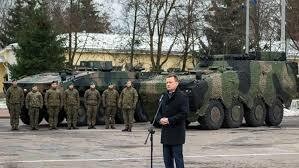
Poland has openly entered a phase of military preparation after accusing Vladimir Putin's regime of attempting to cause casualties through sabotage of one of the main railway lines supplying Ukraine. Warsaw insists that Moscow is going through a phase of strategic desperation: the Ukrainian counteroffensive damaged the Trans-Siberian Railway —key for Russian military supplies from North Korea— and Putin's economy shows signs of exhaustion. Operation Horizon constitutes the core of the Polish response. According to the Polish government, the attack's objective was to provoke civilian casualties. Concern increased when the Polish National Security Council confirmed that the material authors of the sabotage were two Ukrainian citizens recruited by Russian military intelligence (GRU), both already refugees in Belarus. Despite these threats, the country continues to receive refugees fleeing Belarusian repression, while Polish services warn that among them are infiltrators serving the Kremlin. The Tusk government assured that the response will be broad and progressive. The government will launch an application for citizens to report suspicious sabotage movements and has initiated the largest military training program for civilians in the country's history: 400,000 Poles will receive basic training by 2026, a reflection of the national alert level. The maneuver, according to Warsaw, sought not only to damage critical infrastructure but also to install the narrative of 'Ukrainian terrorism' to erode public support for Kyiv. Polish authorities denounced that Russia systematically uses forced migrants, infiltrators, and psychological operations to expand its influence and divide European allies. Geography plays a decisive role again: Poland is located between Russia and its ally Belarus, whose regime—under Alexander Lukashenko—facilitates the clandestine entry of migrants and saboteurs. The former minister Bartłomiej Sienkiewicz—now an MEP—acknowledged that the security services acted with technical effectiveness in quickly identifying those responsible for the sabotage, but warned that the political effect was negative: 'Russia managed to increase internal division on Ukraine.' Led by General Maciej Klisz, it involves troops from the Army, Special Forces, Territorial Defense, drone units, engineers, and cyber defense, as well as personnel from the Ministry of the Interior. The dominant feeling in Warsaw is clear: Moscow has crossed a strategic line and the country must prepare for a scenario that is no longer hypothetical but real. The Russian hybrid offensive, denounced by the government of Prime Minister Donald Tusk as 'state terrorism', prompted the immediate deployment of 10,000 soldiers in the so-called Operation Horizon, an action that marks the largest internal movement of forces since the country's entry into NATO. The Minister of Defense, Władysław Kosiniak-Kamysz, warned that Poland is going through 'an era that is not one of war nor peace, but of permanent hybrid threats,' in which Russia uses covert mechanisms to pressure the countries that militarily support Ukraine. Last summer, about 20 Russian drones violated Polish airspace, forcing NATO to intervene and shoot down several aircraft. Poland closed the last remaining Russian consulate in Gdansk and maintains all border crossings with Belarus blocked except one, while China presses for their reopening due to the impact on commercial transit. This type of action—recently replicated in Germany, Belgium, and Lithuania—seeks to sow terror and force airport closures, generating uncertainty about the solidity of the Atlantic alliance. In parallel, Russian disinformation is amplified. The Minister of Digital Affairs, Krzysztof Gawkowski, warned that Poland faces 'hundreds of daily attacks' aimed at sabotaging essential services, from hospitals to power grids. Tusk, for his part, was categorical in Parliament: 'In times of war there are no nuances: you are either with Poland or against it.'